






Choosing the right Filter Funnel in 2026 requires more than comparing prices or glass shapes. It requires matching flow rate, material compatibility, filtration precision, and cleaning demands. A 90-millimetre funnel may suit a small gravity filtration task, while a 500-millilitre Büchner funnel needs a compatible vacuum flask and sealed adapter. Small mismatches can cause leaks, slow drainage, or contaminated samples. Fit matters.
Recent industry research supports this careful approach. MarketsandMarkets’ Laboratory Filtration Market report identifies pharmaceutical quality control, bioprocessing, food testing, and environmental analysis as major growth areas through 2029. Grand View Research also reports continued expansion in laboratory equipment demand, supported by stricter testing requirements and increased research activity. These trends suggest that funnel selection will become more application-specific, not simply equipment-based. A funnel used for solvent filtration should withstand chemical exposure, while one used for aqueous samples may prioritize rapid flow and easy cleaning.
Standards also deserve attention. ISO 3310-1 provides guidance for test sieves, while ASTM laboratory practices emphasize controlled sample preparation and repeatable results. These references do not select a funnel for you. They establish a disciplined framework. Check pore size, filter-paper diameter, stem length, and connection type before ordering. Then verify whether borosilicate glass, polypropylene, PTFE, or stainless steel suits the process. Details matter. Even experienced users can overlook dead volume or an unstable bench setup. That is where this guide remains intentionally practical: the “best” Filter Funnel may still be wrong when sample volume, viscosity, temperature, or cleaning time changes.
Choosing a filter funnel starts with the sample, not the catalogue. Define the solid size, liquid viscosity, volume, temperature, and required clarity. A coarse particulate slurry needs a wider funnel and larger openings. Fine precipitates need controlled pore size and gentle washing. For routine suspended-solids testing, U.S. EPA Method 160.2 uses a glass-fiber filter and drying at 103–105°C. This temperature range matters when selecting materials that will not deform or release contaminants.
Operating conditions can change the choice quickly. Vacuum filtration shortens drainage time, but excessive pressure may crack fragile filter media or force particles through weak points. Check chemical compatibility before use, especially with solvents, acids, and alkaline solutions. ISO 3310-1 provides controlled test-sieve apertures, while ASTM E11 defines standardized wire-cloth classifications. These references help convert “fine” or “fast” into measurable specifications. That is often where selection improves.
Keep the workflow visible. Measure the largest batch volume, record the expected cake thickness, and leave enough headroom to prevent spills. A narrow funnel may look efficient. It can clog within minutes. I have also seen operators choose the smallest pore size first, then blame the filter for slow flow. That assumption deserves reconsideration. In 2026, compare throughput data under your actual temperature, pressure, and viscosity conditions, not only the nominal pore rating. Small trials reveal more than confident guesses.
Select the fritted-glass funnel porosity class according to the smallest particles that must be retained. Lower pore sizes improve particle retention but generally require longer filtration times and higher pressure or vacuum.
Typical nominal pore-size ranges: G1 100–160 µm, G2 40–100 µm, G3 16–40 µm, G4 10–16 µm, and G5 1–1.6 µm. Confirm chemical compatibility, temperature limits, pressure or vacuum requirements, and actual supplier specifications before operation.
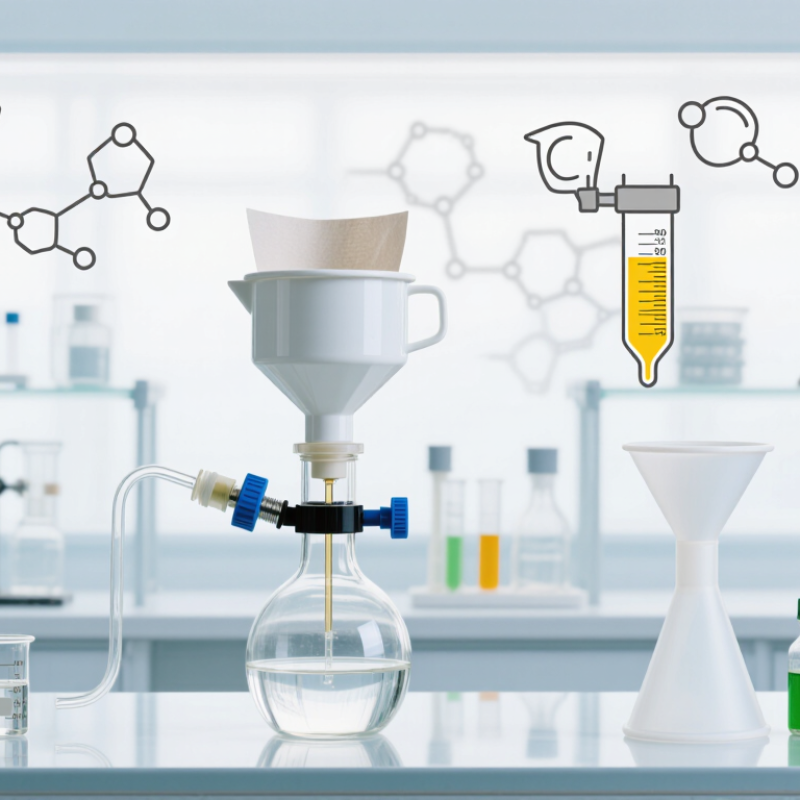
A filter funnel should match the liquid, solid, and filtration method. A standard gravity funnel works well for coarse particles and moderate volumes. Its long stem directs liquid neatly into a narrow vessel. For faster separation, a Büchner funnel uses vacuum pressure with filter paper. It needs a compatible flask and a secure seal. Small funnels suit analytical samples, while larger designs reduce repeated transfers.
Material affects chemical resistance, durability, and visibility. Glass handles many solvents and tolerates heat better than most plastics. It also shows residue clearly. However, glass can break during clumsy handling. Polypropylene is lightweight and resists many laboratory chemicals. PTFE offers broad chemical resistance, but its higher cost may not suit routine work. Porcelain provides strong vacuum support and tolerates heat, though it hides the filtration process.
Design details often decide daily performance. A ribbed inner surface can improve drainage, while a smooth surface is easier to clean. Stem length matters when splashing is a concern. Check the funnel diameter against the filter paper and receiving vessel.
I once chose a narrow funnel for a high-solid sample; clogging followed quickly. That mistake still matters.
A wider funnel would have helped, but it would not solve every problem. Consider filtration speed, cleaning access, vacuum compatibility, and operator comfort. Manufacturer specifications and chemical-resistance data deserve careful review before purchase.
Choosing a filter funnel begins with the sample, not the funnel.
The filter medium controls chemical compatibility, flow, and particle retention. Cellulose-based media suit many aqueous samples, while glass fiber handles heavier solids and faster loading. For solvent-rich or aggressive liquids, a chemically resistant membrane is safer. Yet “universal” media are rarely universal. I still test a small volume first. An unexpected solvent can soften the support or slow filtration dramatically.
Pore size should match the target, not simply the clearest final liquid.
The EPA’s Membrane Filtration Guidance Manual describes microfiltration as roughly 0.1–10 micrometres. It places ultrafiltration near 0.01–0.1 micrometres, with nanofiltration around 0.001–0.01 micrometres. These ranges are useful starting points, not promises.
ASTM F316 uses bubble-point testing to estimate membrane pore size. A 0.45-micrometre filter may clarify a sample, but it will not remove every dissolved substance. That distinction matters.
Tips:
Check solvent compatibility, operating temperature, and funnel diameter before ordering. Use a coarse prefilter when the liquid carries visible solids. Record the filter medium, pore size, pressure, and flow time.
The WHO Guidelines for Drinking-water Quality emphasizes validated testing, so visual clarity alone is weak evidence. Test first. Reflect afterward.
Choosing a filter funnel starts with the sample volume, not the product shape. A small funnel suits occasional 50–100 millilitre transfers, while larger vessels reduce repeated pouring. However, oversized funnels can waste liquid and slow filtration. I have found that capacity should match the working batch closely, with a little room for foaming or sediment.
Choosing a filter funnel starts with the sample volume, not the product shape.
Compatibility needs careful checking. Confirm that the funnel, membrane, and gasket resist the solvent, temperature, and cleaning method. Glass may handle heat well, while selected plastics can reduce breakage during routine work. Vacuum filtration can improve speed, but only when the funnel and flask are rated for reduced pressure. A faster setup is not always better. Excessive suction may compact the filter cake and restrict flow.
Tips: Test a small batch first. Measure the filtration time, recovered volume, and visible residue. Compare gravity and vacuum methods under the same conditions. For reusability, choose smooth surfaces with few crevices. Clean immediately after use, then inspect seals for swelling, cracks, or trapped particles. A funnel may appear clean but still hold residue. That is easy to miss. Record cleaning cycles, because performance can decline before damage becomes obvious. I sometimes favor a slower funnel when it gives cleaner results and more predictable maintenance.
Choosing the Right Filter Funnel in 2026
Choosing the right filter funnel starts with safety, not appearance. Check the material against the liquid, temperature, and pressure used in your process. A funnel that feels solid can still crack after repeated heating. Look for safety documentation, secure connections, and a stable base. In routine lab checks, small slips caused more trouble than slow filtration. Keep hands dry. Never force a blocked filter. Inspect seals before each use, and replace them when they harden, discolor, or lose shape. This is easy to neglect.
Maintenance affects both cost and reliability. Choose a design with smooth surfaces and removable parts, so residue cannot hide in narrow joints. Rinse it promptly, then follow cleaning instructions for detergents, solvents, and drying temperatures. Aggressive cleaning may shorten its service life. I once favored the cheapest option, but its fragile seal required frequent replacement. The purchase price looked attractive; the ownership cost did not. Compare the funnel, spare seals, cleaning time, downtime, and waste over several years. A higher initial cost may be reasonable when parts remain available and performance stays consistent. Still, expensive does not automatically mean durable. Record flow time, leakage, and inspection dates. These notes reveal whether the funnel supports your actual workload. Choose for the process you run, not the process shown in a catalog.
| Filter Funnel Type | Typical Material | Best Use | Safety Considerations | Maintenance Level | Typical Purchase Cost1 | Expected Service Life2 | Long-Term Value | Recommended Choice When... |
|---|---|---|---|---|---|---|---|---|
| Disposable paper funnel | Cellulose filter paper with a paper or plastic support funnel | Routine gravity filtration of low-risk, water-based samples | Use the correct paper grade; paper may tear when overloaded or exposed to strong solvents | Low; replace after use and dispose of according to residue hazards | About US$0.10–$2 per assembly | Single use | Good for occasional work because there is no cleaning or storage cost | Low upfront cost and fast changeover matter more than waste reduction |
| Reusable glass Büchner funnel | Borosilicate glass with a perforated plate | Vacuum filtration of precipitates and laboratory solids | Inspect for chips and cracks; use compatible filter paper and suitable vacuum equipment; protect against implosion | Medium; rinse promptly, wash thoroughly, and inspect before reuse | About US$25–$150 | 3–10 years with careful handling | High for frequent vacuum work because the funnel is reusable and chemically resistant to many common liquids | A stable, chemically resistant vessel is needed for repeated laboratory filtration |
| Porcelain Büchner funnel | Glazed laboratory porcelain | Vacuum filtration where rigidity and heat tolerance are useful | Avoid thermal shock; check for hairline cracks; use proper vacuum support and a protective screen where required | Medium; remove residue before it dries and inspect the glaze | About US$30–$180 | 5–15 years with proper handling | High in demanding routine use, but breakage can create a higher replacement cost | A durable, rigid funnel is preferred and operators can control temperature changes |
| Stainless-steel filter funnel | Stainless steel, commonly 304 or 316 grade | Industrial liquid filtration, sanitary processing, and repeated mechanical use | Confirm alloy compatibility with chlorides, strong acids, and cleaning chemicals; avoid cross-contamination | Medium to high; clean, rinse, dry, and periodically verify the mesh or perforated plate | About US$40–$300 | 5–15+ years, depending on corrosion and wear | Very high for high-throughput operations because it tolerates frequent handling and cleaning | The funnel must withstand repeated use, mechanical stress, and controlled cleaning procedures |
| PTFE filter funnel | Polytetrafluoroethylene | Highly corrosive or chemically aggressive liquids | Check the temperature rating and mechanical limits; PTFE can deform under load at elevated temperatures | Medium; rinse with a compatible solvent and prevent particle buildup in the porous support | About US$100–$600 | 3–10 years, depending on temperature and chemical exposure | High where chemical compatibility prevents premature replacement or contamination | Chemical resistance is more important than the lowest initial purchase price |
| Fritted-glass filter funnel | Porous sintered borosilicate glass | Fine-particle filtration without separate filter paper | Prevent sudden pressure changes; avoid abrasive scraping; verify the frit grade and inspect for blocked pores | High; back-flush or chemically clean according to the material and residue | About US$60–$350 | 3–10 years if the frit remains unclogged and intact | High for repeated fine filtration, but cleaning labor and clogging risk must be included in total cost | Consistent fine filtration is required and the team can follow a controlled cleaning method |
| Plastic vacuum filter funnel | Polypropylene or another laboratory-grade thermoplastic | Low-cost vacuum filtration and field or teaching applications | Confirm chemical and temperature compatibility; inspect for distortion, crazing, and leaks before applying vacuum | Low to medium; wash promptly and avoid incompatible solvents | About US$10–$100 | 1–5 years, depending on exposure and handling | Good when low weight and low replacement cost outweigh maximum chemical resistance | Portability, impact resistance, and budget control are key requirements |
| Pressure filter funnel | Metal or engineered polymer housing with a replaceable filter medium | Faster filtration of larger volumes in controlled process systems | Never exceed the rated working pressure; use compatible seals, fittings, and pressure relief procedures | High; replace filter media, inspect seals, and document pressure-test or service checks | About US$150–$1,500+ | 5–15 years for the housing with proper servicing | Very high at larger volumes because reduced filtration time can offset higher capital and maintenance costs | Throughput, process control, and labor savings justify a higher initial investment |
Selection priorities for 2026: Confirm chemical compatibility, temperature and pressure limits, required pore or mesh size, connection dimensions, cleaning method, and the cost of replacement filter media before purchase.
1 Cost ranges are approximate planning values in U.S. dollars for general laboratory and light industrial equipment; actual prices vary by size, specification, and filtration area.
2 Service life is a practical estimate, not a warranty. It depends on chemical exposure, temperature, pressure, cleaning frequency, impact, and inspection practices.
No account yet?
Create an Account