
Choosing among the Top 10 Types of Window Awnings is more practical than it first appears. A retractable fabric awning may suit a sunny patio, while a fixed metal canopy may protect a narrow shop entrance. Dome, concave, waterfall, and motorized styles each change the way light, rain, and air move around a window. The right choice depends on more than appearance. It must fit the wall, window size, climate, maintenance habits, and budget.
As awning designer John M. Barba explains, “The best awning controls sunlight without competing with the building.” That principle is useful, although it is not a complete answer. A pale canvas can soften harsh afternoon glare, yet it may show dust quickly. A dark fabric can create stronger shade, but it may absorb more heat. Small details matter. Frame strength matters. Installation quality matters more than many buyers expect.
This guide compares ten common Window Awnings styles through real-world considerations, including durability, ventilation, privacy, operation, and visual character. You will see where each design performs well and where it can disappoint. Some options look impressive in a showroom but feel excessive on a compact home. Others seem plain, then quietly reduce indoor glare every afternoon. There is no universal winner. Even this guide has limits, because local weather and building conditions can change the result. The best awning is the one that works reliably on your actual window.
Top 10 Types of Window Awnings: Which Is Best?
Window awnings control sunlight before it reaches the glass. This is their main advantage. The U.S. Department of Energy reports that exterior awnings can reduce solar heat gain by up to 65% on south-facing windows and 77% on west-facing windows. Actual results vary with fabric, color, window orientation, and local climate.
Solar Heat Gain Coefficient, or SHGC, measures how much solar energy enters through a window. A lower SHGC usually means less indoor heat. The National Fenestration Rating Council describes SHGC on a scale from 0 to 1. Projection also matters. A deeper awning creates more shade, especially during high summer sun. However, excessive projection can reduce daylight and winter warmth. A neat calculation can still mislead.
Tips: Match the awning to the window’s direction. Use greater projection on west-facing glass, where late afternoon sun is difficult. Choose light-colored, tightly woven fabric for strong summer reflection. Check the NFRC rating, then compare it with local weather data. The International Energy Agency notes that solar control can reduce cooling demand, but shading alone cannot fix poor insulation or air leakage. In field assessments, performance is often less dramatic than brochures suggest. Measure indoor temperature before and after installation. That small test may reveal whether the chosen awning is truly effective.
Top 10 Types of Window Awnings: Which Is Best?
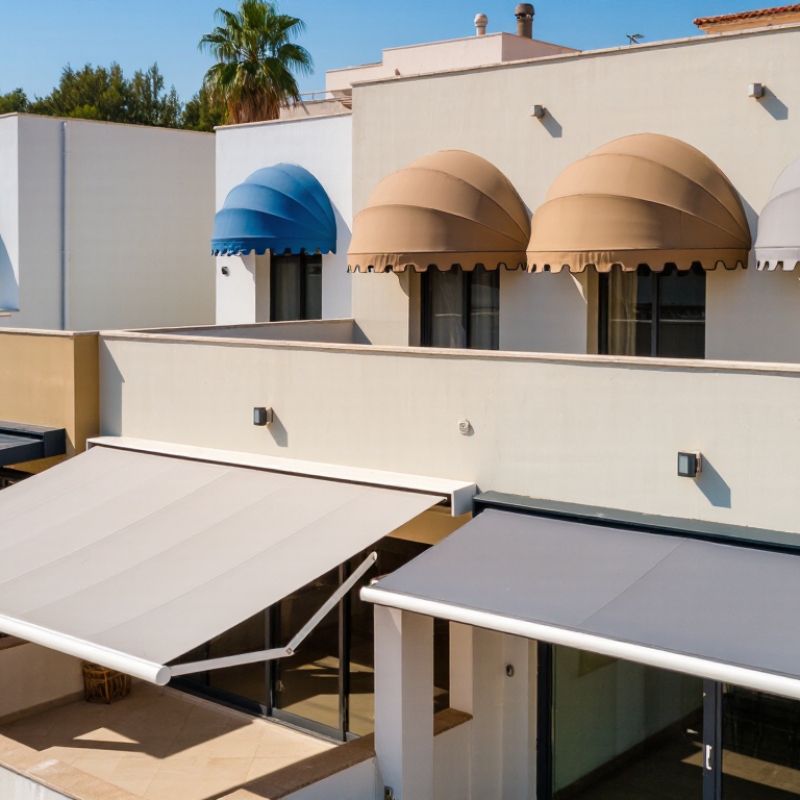
Window awnings fall into ten practical types, classified by design, mounting, and operation. Design options include fixed, retractable, dome, convex, waterfall, and traditional sloped awnings. Fixed awnings provide constant shade. Retractable models offer seasonal control. Dome styles protect projecting windows from rain. Convex forms suit rounded façades, while waterfall awnings direct water away from glazing. Traditional sloped awnings remain simple and effective.
Mounting creates three more categories: wall-mounted, roof-mounted, and soffit-mounted awnings. Wall mounting works well on masonry façades. Roof mounting suits upper windows but needs careful flashing. Soffit mounting creates a cleaner appearance beneath eaves. The tenth type is the operating method: manual or motorized retractable systems. In practice, operation can be treated as a major selection class because controls affect daily usability.
The U.S. Department of Energy reports that exterior awnings can reduce solar heat gain by up to 65% on south-facing windows and 77% on west-facing windows. The IEA’s Buildings 2023 report states that buildings account for about 30% of global final energy use, making passive shading worth serious attention. Still, these figures depend on orientation, fabric openness, window glass, and local climate. A west-facing bedroom may need a deeper projection than a shaded north-facing office. I have seen attractive awnings fail because installers ignored wind exposure and drainage. Motorization is convenient, but it adds maintenance points. The best choice is rarely the most expensive one.
| No. | Window Awning Type | Design Classification | Mounting Method | Operating Method | Main Advantages | Potential Limitations | Best Suited For | Overall Suitability |
|---|---|---|---|---|---|---|---|---|
| 1 | Retractable Drop-Arm Awning | Fabric canopy supported by articulated folding arms; the fabric rolls onto a top tube when retracted. | Usually mounted above the window frame, on the wall, soffit, or a suitable structural surface. | Manual crank or motorized operation; optional sensors can help control sun and wind exposure. | Provides adjustable shade, preserves an open view when retracted, and can improve indoor solar control. | Moving arms and fabric require periodic inspection; extended fabric may be vulnerable to strong wind. | Homes and commercial windows where flexible shade control is important. | ★★★★★ |
| 2 | Fixed Frame Awning | Permanent fabric or metal-covered canopy stretched over a rigid frame. | Attached directly to the wall or window surround with fixed brackets and a supporting frame. | Stationary; it does not retract or adjust after installation. | Strong visual definition, dependable everyday shade, and relatively simple operation because there are no moving parts. | Shade angle cannot be changed, and the awning must be designed for the local wind and weather conditions. | Windows requiring continuous shading and a stable architectural appearance. | ★★★★☆ |
| 3 | Window Door Canopy Awning | Compact, shallow canopy with a projecting top plane, commonly using fabric, polycarbonate, or metal panels. | Mounted above a window or door with wall brackets, side supports, or a small frame. | Normally fixed; some fabric versions may use simple removable or folding supports. | Helps shelter glazing and entrances from rain while adding modest sun protection. | Offers less adjustable shade than a retractable system and may not cover wide windows effectively. | Entry doors, narrow windows, and locations needing basic weather protection. | ★★★★☆ |
| 4 | Dome Awning | Curved, semi-domed canopy that projects outward from the wall and often covers the sides of the window. | Fixed to the wall above the window using brackets or a shaped support frame. | Usually stationary; retractable dome versions are less common. | Provides distinctive decorative appeal and partial protection from overhead sun and light rain. | Curved construction can be more difficult to clean, repair, or replace than a flat canopy. | Bay windows, storefront-style windows, and façades where appearance is a major consideration. | ★★★★☆ |
| 5 | Quarter-Barrel Awning | Rounded quarter-cylinder profile with a curved roof and usually enclosed or framed sides. | Wall-mounted above the window with curved ribs or a custom support structure. | Generally fixed and non-adjustable. | Creates a strong curved profile and can provide good coverage across the top and sides of a window. | Uses more visual and structural volume than a flat awning and may be less suitable for very limited wall space. | Traditional façades, accent windows, and projects seeking a prominent architectural feature. | ★★★☆☆ |
| 6 | Waterfall Awning | Sloped or curved fabric design that falls downward from the top of the window, sometimes with a decorative scalloped edge. | Installed above the window using a top roller, fixed rail, or wall brackets. | May be fixed or manually retractable, depending on the frame and roller design. | Combines overhead shading with a decorative front drop and can reduce glare from low-angle sunlight. | The hanging front section can obstruct views and may move in windy conditions. | Windows needing stronger visual screening or a traditional decorative treatment. | ★★★☆☆ |
| 7 | Roller Window Awning | Flat fabric or mesh screen that rolls around a tube and extends vertically or at a slight outward angle. | Mounted above the window, inside a recess, or on the exterior face of the wall, depending on the system. | Manual chain, spring, crank, or motorized operation. | Compact when raised, offers precise coverage, and can be made with solar-screen fabrics for glare and heat control. | Exterior versions need suitable protection from wind; side gaps can allow some sunlight to enter. | Modern homes, offices, balconies, and windows requiring a clean, space-efficient shade. | ★★★★★ |
| 8 | Vertical Drop Awning | Screen-like panel that drops vertically along the outside of the window, sometimes with side tracks or guide wires. | Top-mounted above the window with side guides, cables, or retaining channels. | Manual pull, crank, spring-assisted, or motorized operation. | Effective for blocking low-angle sunlight, reducing glare, and improving privacy without a large outward projection. | Provides less overhead rain protection and may need secure guides in exposed locations. | West-facing windows, balconies, patios, and façades with limited projection space. | ★★★★★ |
| 9 | Louvered or Adjustable-Shutter Awning | Series of angled slats or louvers that can be fixed or adjusted to regulate light and airflow. | Hinged or framed to the wall, window surround, or side reveals. | Manual adjustment, folding, hinged opening, or motorized control in advanced installations. | Allows directional control of sunlight and can support ventilation while maintaining a degree of privacy. | More components may increase cleaning and maintenance needs; it may provide less fabric-like rain protection. | Hot climates, privacy-sensitive rooms, and windows where airflow is desirable. | ★★★★☆ |
| 10 | Retractable Side-Track Awning | Vertical fabric or mesh shade guided by side channels, tracks, or tensioned cables. | Mounted above the window with side tracks attached to the wall, frame, or surrounding structure. | Manual, spring-assisted, crank-operated, or motorized retraction. | Offers controlled shading and privacy, remains close to the wall, and performs better than free-hanging screens in moderate breezes. | Requires accurate installation and clear side-track alignment; not every system is designed for severe wind. | Large windows, outdoor rooms, balconies, and spaces needing both shade and privacy. | ★★★★★ |
Window awnings include retractable, fixed, drop-arm, dome, convex, concave, door, patio, motorized, and solar-screen designs. The best choice depends on window direction, climate, fabric, and installation quality. According to the U.S. Department of Energy, well-designed awnings can reduce solar heat gain by about 65%–77%. That figure is useful, but it is not a promise for every home.
South- and west-facing windows usually gain the most from exterior shading, especially during hot afternoons. Fixed awnings provide steady protection, while retractable models offer more daylight and seasonal control. Drop-arm awnings suit narrow windows. Dome styles can handle rain better, though they may limit ventilation. Motorized options add convenience, but they need reliable controls and careful maintenance. My first instinct was to call retractable awnings the best overall. That assumption feels too simple. A properly sized fixed awning may perform better than an expensive system installed too shallowly. Fabric color, projection, side coverage, and airflow also matter.
Tips: Measure the glass area, not only the frame. Check the window’s compass direction. Choose breathable, weather-resistant fabric. Leave enough clearance for ventilation. Ask for heat-gain testing or installation details, not vague savings claims. Inspect hinges, seams, and mounting points each season. Small errors matter.
Top 10 Types of Window Awnings: Which Is Best?
Climate should guide your awning choice. Fixed awnings suit hot, dry regions with predictable weather. Retractable awnings work better where winter sunlight remains useful. Roller shades, solar screens, and louvered awnings offer adjustable control. In humid climates, breathable fabrics can reduce trapped moisture and mildew. The U.S. Department of Energy reports that awnings may reduce solar heat gain by up to 65% on south-facing windows and 77% on west-facing windows. Orientation matters more than appearance.
West-facing glass often receives harsh afternoon sun. Dome, waterfall, and convex awnings can provide deeper side protection there. North-facing windows usually need less shading. In snowy climates, rigid structures require strong brackets and careful drainage. Wind changes the decision. ASCE 7-22 design guidance shows that local wind speed, exposure, and building height affect exterior attachment loads. A small awning can still fail when gusts lift its edge. Check the product’s tested wind rating, not only its fabric weight.
Maintenance is often underestimated. Wash fabric gently, inspect seams, and clear leaves from drainage points. Aluminum and polycarbonate models need fewer fabric repairs, but they still need hardware checks. Solar screens may collect dust quickly beside busy roads. This is where the “best” option becomes less obvious. A retractable model offers flexibility, yet its moving parts demand attention. A fixed awning is simpler, but it may block welcome winter warmth. Local climate records, window orientation, wind exposure, and realistic maintenance habits should decide the final type.
Comparative suitability ratings based on climate adaptability, window orientation, wind resistance, and maintenance needs.
Fixed metal and louvered awnings generally perform well in strong sun and wind, while retractable fabric awnings offer flexible shade but require more care during storms. Drop-arm and solar-screen awnings are practical for east- and west-facing windows, where low-angle morning and afternoon sunlight is most difficult to control. Ratings use a 1–5 comparative scale, with higher scores indicating better suitability.
Top 10 Types of Window Awnings: Which Is Best?
Choosing among retractable, fixed, roll-up, drop-arm, dome, waterfall, louvered, solar-screen, motorized, and fabric awnings requires more than appearance. I have found that a sunny south-facing window needs different protection than a shaded porch window. NFRC ratings can help compare solar heat gain and visible transmittance, but they may not describe every awning system. Check the product data, installation method, and window orientation. A lower solar heat gain value often means less indoor heat. However, correct installation matters greatly.
Cost varies widely. Fixed awnings usually cost less, while motorized and custom systems cost more. Measure carefully. Small errors can cause water leaks or weak shade. Aluminum and treated steel frames can withstand harsh weather. Acrylic or solution-dyed fabrics may resist fading better. Fabric still needs cleaning and may wear faster in coastal air. A realistic lifespan often ranges from five to fifteen years. Weather, maintenance, and seasonal removal affect that range.
For many homes, a fixed or retractable awning balances cost, durability, and control. Motorized models suit hard-to-reach windows, but their controls add repair points. Dome awnings protect curved windows effectively. Louvered designs improve airflow, though they may cost more. My earlier choice favored the cheapest option. I regretted it after two seasons. Ask about wind limits, warranty terms, NFRC-related data, and replacement-part availability.
No account yet?
Create an Account