












Top Skincare Pump Manufacturers for Global Buyers
Global buyers evaluating a Skincare Pump need more than attractive samples. They need repeatable dosing, dependable priming, clean shutoff, and packaging that suits each formula. A pump that performs well with a light lotion may struggle with a thicker cream. Small parts matter.
Grand View Research’s Cosmetic Packaging Market report estimated the global market at USD 34.8 billion in 2023, with projected growth through 2030. This figure covers cosmetic packaging broadly, not skincare pumps alone. It still signals the scale and competition shaping supplier choices. Buyers should treat market forecasts as context, then verify claims against samples, test records, and clear specifications.
Dieter Rams, a leading product-design authority, offered a useful principle: “Good design is as little design as possible.” For pump sourcing, that principle means simple operation without sacrificing dose control, compatibility, or user comfort. It is a design lens, not a technical standard.
This guide compares manufacturers through practical questions: Can they support different viscosities? Do they document output per stroke, leak testing, and material options? Can they maintain consistent quality across production runs? Request evidence, not just polished brochures. A shortlist is never perfect. Supplier capabilities change, and a promising sample does not guarantee identical production performance. The strongest global buying decisions pair credible data with hands-on testing and direct supplier checks.
Understanding Skincare Pumps and Their Role in Product Packaging
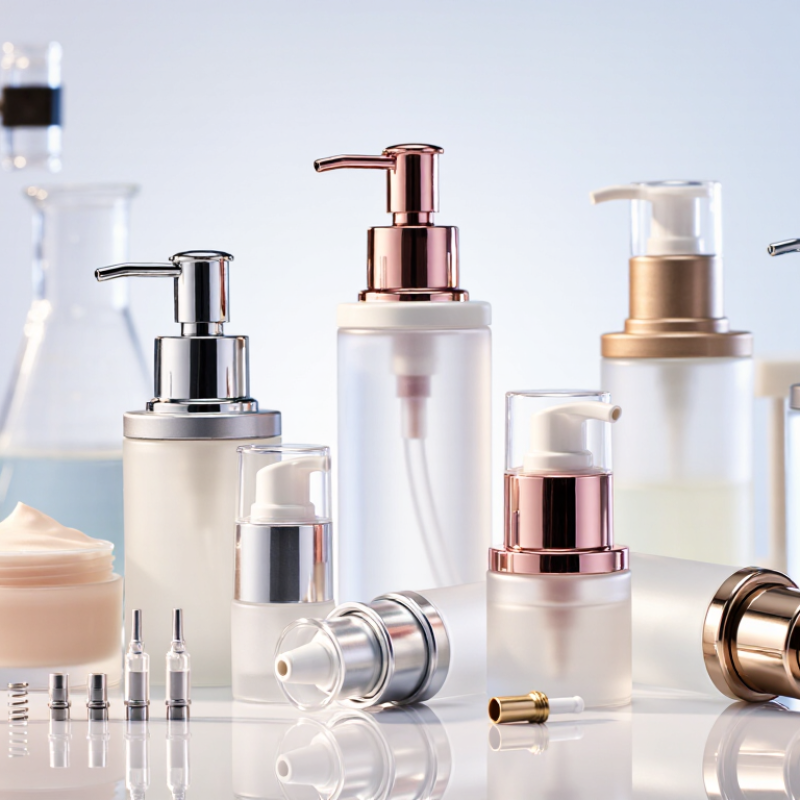
A skincare pump is more than a convenient dispenser. It controls how a formula leaves the container and how easily people can use it. With one press, a lotion or serum should deliver a reasonably consistent amount without dripping across the bottle neck. That matters when users apply product with clean hands or dispense it beside a sink. Small details matter. The actuator should feel easy to press, while the closure helps protect the contents during storage and travel.
Pump choice depends on the formula. A thick cream may need a wider passage than a light serum, and a poorly matched pump can clog or dispense unevenly. Airless designs can limit repeated exposure to air, but they are not automatically right for every product. They may also leave some formula behind. Packaging teams should test the actual formula with the intended pump, checking dose consistency, leakage, and performance after repeated use. A pump does not make a formula sterile, and claims about protection should be based on testing. Compatibility can be frustratingly easy to assume. Real use sometimes proves otherwise.
Top Skincare Pump Manufacturers for Global Buyers - Understanding Skincare Pumps and Their Role in Product Packaging
| Pump format | Common skincare applications | How it dispenses | Packaging and material considerations | Key buyer checks |
|---|---|---|---|---|
| Lotion pump | Body lotion, hand cream, cleanser, and other pumpable lotions | A spring-driven piston draws product through a dip tube and dispenses it through the actuator. | Often paired with plastic bottles. Pump components may use polypropylene (PP), polyethylene (PE), or other compatible polymers; material choice varies by design. | Check dose consistency, dip-tube fit, closure size, priming, leakage, and compatibility with the formula. |
| Treatment pump | Serums, facial treatments, liquid moisturizers, and targeted-care products | A compact dispensing mechanism releases a measured portion when the actuator is pressed. | Commonly used with small bottles. The actuator and outlet should suit the product’s viscosity and dispensing needs. | Evaluate dose repeatability, clogging risk, user control, and whether the formula remains stable in contact with the selected materials. |
| Airless dispenser | Creams, gels, lotions, and formulas for which limiting contact with outside air is a packaging priority | A piston or flexible pouch moves product toward the outlet as the contents are dispensed, reducing the need for a conventional dip tube. | Available in several bottle and cartridge constructions. “Airless” describes the dispensing system and does not by itself guarantee a sterile or fully oxygen-proof package. | Test evacuation, priming, sealing, formula compatibility, and performance through the intended fill and use cycle. |
| Foam pump | Foaming facial cleansers and hand or body washes formulated for foaming dispensers | The pump mixes liquid with air through a foaming mesh or similar component to produce foam at the outlet. | Designed for suitable, generally low-viscosity formulas. The pump and formula need to be developed or validated together. | Confirm foam quality, mesh performance, formula viscosity, priming behavior, and resistance to blockage. |
| Fine-mist pump | Facial mists, toners, and other sprayable, low-viscosity liquids | A small orifice and internal components atomize liquid into droplets when the actuator is pressed. | Usually paired with bottles suitable for liquid formulations. Spray pattern depends on the pump design and the product’s properties. | Assess spray pattern, droplet consistency, leakage, actuator comfort, and compatibility with the formula. |
| Locking pump | Travel-oriented or everyday skincare bottles where accidental actuation should be reduced | A twist, clip, or other locking feature helps prevent the actuator from dispensing while secured. | Can be incorporated into different pump styles. Locking mechanisms and closure configurations vary by design. | Check lock reliability, ease of use, shipping performance, and whether the locked pump fits the chosen bottle and cap. |
Note: Pump performance depends on the specific design, bottle, fill process, and skincare formula. Confirm specifications and conduct compatibility, leakage, transport, and dispensing tests with production-intent components.